

-
About RychenFocus on high-tech research and development, energy-saving product design and production in the fields of fluid transportation (water pump, fan), fine control combustion, high-efficiency heat exchange and high-efficiency permanent magnet motor, and provide professional technical transformation services to provide users with professional comprehensive energy-saving solutions.

-
SolutionFocus on high-tech research and development, energy-saving product design and production in the fields of fluid transportation (water pump, fan), fine control combustion, high-efficiency heat exchange and high-efficiency permanent magnet motor, and provide professional technical transformation services to provide users with professional comprehensive energy-saving solutions.
-
ProductsFocus on high-tech research and development, energy-saving product design and production in the fields of fluid transportation (water pump, fan), fine control combustion, high-efficiency heat exchange and high-efficiency permanent magnet motor, and provide professional technical transformation services to provide users with professional comprehensive energy-saving solutions.
-
BlogWe focus on high-tech research and development, energy-saving product design and production in the fields of fluid transportation (water pump, fan), fine control combustion, high-efficiency heat exchange and high-efficiency permanent magnet motor, and provide professional technical transformation services to provide users with professional comprehensive energy-saving solutions.
High reliability technology of permanent magnet anti-demagnetization
Release time:
2024-06-20
The main factors affecting the stability of permanent magnets are as follows: • Permanent magnet material demagnetization due to temperature change • Permanent magnet material demagnetization caused by external demagnetization field • Weakening of magnetic properties due to the influence of chemical factors • Temporal demagnetization
The main factors affecting the stability of permanent magnets are as follows:
• Permanent magnet material demagnetization due to temperature change
• Demagnetization of Permanent Magnetic Materials Caused by External Demagnetization Field
• The influence of chemical factors leads to the weakening of magnetic properties
• time demagnetization
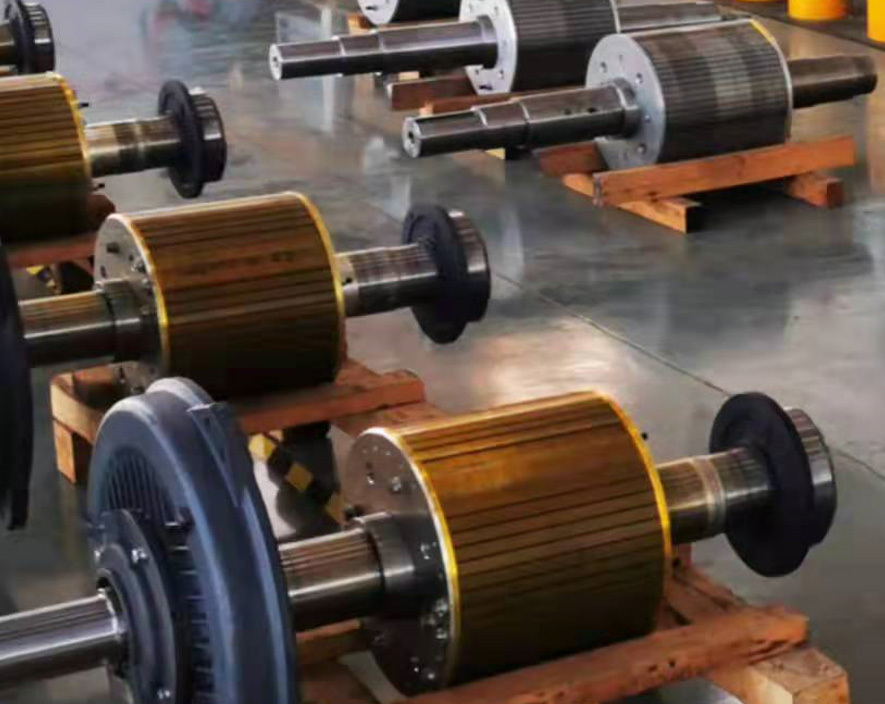
Thermal stability refers to the degree to which the magnetic properties of a permanent magnet change due to a change in the temperature to which it is exposed. In view of the influence of temperature on the performance of permanent magnets, we make the permanent magnets safe and reliable in operation by adopting reasonable structure and cooling system. In the process of the factory temperature rise test, when the temperature of the stator winding reaches the limit value, the irreversible demagnetization phenomenon of the permanent magnet does not occur. At present, the magnetic steel with temperature resistance grade of 200 ℃ can be stably provided in the market, and the magnetic steel with temperature resistance grade of 350 ℃ can also be provided.
Magnetic stability represents the magnitude of the change in the properties of a permanent magnet material under an external magnetic field. For permanent magnet synchronous motors, the external magnetic field is the strongest in the case of a fault. Through the modeling and analysis of the electromagnetic field, the curve of the working point of the permanent magnet with the speed change is calculated, and the shape and placement of the permanent magnet are reasonably selected to improve its magnetic stability, so as to ensure that the permanent magnet will not be irreversible demagnetization during operation and failure. In the motor type test, the permanent magnet is detected for irreversible demagnetization after the short-circuit test.
The chemical stability of the permanent magnet is affected by chemical factors such as acid and alkali, oxygen, hydrogen, etc., and the internal or surface chemical structure of the permanent magnet material will change, which will seriously affect the performance of the permanent magnet. For example, neodymium in neodymium iron boron permanent magnets are easy to absorb hydrogen and cause hydrogen fragmentation, and iron and neodymium are also easy to oxidize. Through the special treatment of permanent magnet surface protection and the overall protection of the magnetic pole, the influence of these chemical factors can be effectively avoided.
The timeliness of permanent magnets refers to the removal of the magnetizing magnetic field after its magnetization to saturation, and its magnetism weakens after a long time. The magnetic properties of permanent magnets are almost no longer weakened over time by thermal aging treatment at higher temperatures, AC demagnetization pretreatment, magnetic contact stabilization treatment, and temperature cycle stabilization treatment.
Contact Us
11/F, Building 1, Guozheng Center, 497 Zhengli Road, Yangpu District, Shanghai
Follow us